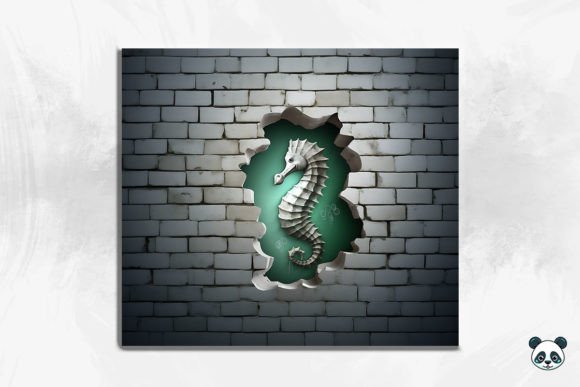
Evaluating the Seahorse from Cracked Hole 3D Tumbler 1 Design for Sublimation Projects
In the competitive landscape of custom drinkware, the difference between a product that sits on a shelf and one that sells often comes down to the sophistication of the artwork. The Seahorse from Cracked Hole 3D Tumbler 1 represents a specific category of digital assets designed to meet the growing demand for depth and realism in sublimation printing. Unlike flat, two-dimensional clip art, this design utilizes a "cracked hole" aesthetic combined with three-dimensional rendering to create an illusion of depth on a straight skinny tumbler. For creators, small business owners, and hobbyists looking to elevate their product offerings, understanding the technical specifications and practical application of such a file is essential before integrating it into a workflow.
The Visual Mechanics of 3D Sublimation Art
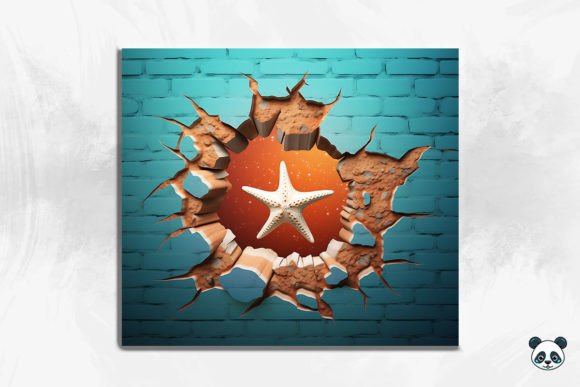
The core appeal of the Seahorse from Cracked Hole 3D Tumbler 1 lies in its visual trickery. Traditional sublimation wraps often struggle to convey texture on a smooth, cylindrical surface. This design addresses that limitation by simulating a breach in the tumbler's surface, revealing a vibrant seahorse and aquatic background as if viewing them through an opening. This approach leverages the psychology of depth perception, making the sea animal appear to float within or behind the steel, rather than simply sitting on top of it.
From a technical standpoint, the effectiveness of this illusion depends heavily on the resolution and layering of the source file. The asset in question is provided as a high-resolution PNG at 300 DPI, with dimensions of approximately 9.3 inches by 8.2 inches. For a standard 20 oz skinny tumbler, which typically requires a wrap width of roughly 8 to 8.5 inches depending on the manufacturer, these dimensions are critical. The height allows for full coverage or strategic placement, while the width ensures the pattern can be tiled or adjusted without significant pixelation. The use of a transparent background in the PNG format is particularly valuable, as it allows the creator to composite this 3D element over solid colors, gradients, or other patterns without unwanted white boxes or hard edges.
Practical Application and Workflow Integration
Integrating the Seahorse from Cracked Hole 3D Tumbler 1 into a production workflow requires more than just dragging and dropping an image into design software. Success depends on how well the creator understands the constraints of sublimation printing. Since this is a digital download intended for instant use, the buyer must possess the necessary software skills to manipulate the file. Tools like Adobe Photoshop, Illustrator, or even user-friendly platforms like Canva Pro are required to position the design correctly on a tumbler template.
One of the primary strengths of this specific design is its versatility within the "sea animal" niche. The oceanic theme remains perennially popular in the handmade goods market, appealing to a broad demographic ranging from beachgoers to marine biology enthusiasts. However, the 3D cracked effect adds a modern twist that differentiates it from standard watercolor or vector sea life illustrations. When applied to a white or light-colored polyester-coated tumbler, the vibrancy of the blues and the details of the seahorse scales can pop significantly, provided the printer profile is calibrated correctly.
It is important to note that because this is a seamless or near-seamless pattern element, it offers flexibility in sizing. If a creator is working with a slightly larger diameter tumbler, the 9.3-inch width provides a buffer. Conversely, for narrower applications, the design can be cropped without losing the central focal point—the seahorse emerging from the crack. This adaptability makes it a reliable asset for inventory management, allowing a single purchase to serve multiple product variations.
Quality Assessment and Technical Limitations
While the artistic concept is strong, a professional evaluation must also address potential limitations. The "cracked hole" effect relies on the contrast between the simulated break and the surrounding area. If the base color of the tumbler does not match the outer edges of the PNG design, the illusion of depth may break. For instance, if the design assumes a silver or white border to mimic the metal of the tumbler, applying it over a black or navy blank could look incongruous unless the creator manually edits the outer edges of the file. This necessitates a level of graphic design proficiency; it is not a "one-click" solution for those entirely unfamiliar with image editing.
Furthermore, the 300 DPI resolution is standard for high-quality print, but scaling the image beyond its native 9.3 x 8.2 inch dimensions will result in a loss of clarity. Creators attempting to use this design on oversized tumblers, such as 30 oz models, may find the image becomes soft or pixelated if stretched too far. In such cases, the design is best used as a central focal panel rather than a full wrap, perhaps complemented by additional patterns or text to fill the remaining space.
Another consideration is the printing process itself. Sublimation involves heat and pressure, which can sometimes shift colors slightly. The intricate details of a 3D render, especially shadows and highlights that create the depth effect, need to be monitored during the test press phase. A design that looks sharp on a monitor may lose some definition if the heat press time or temperature is not optimized for the specific blank being used.
Target Audience and Commercial Viability
Who benefits most from acquiring the Seahorse from Cracked Hole 3D Tumbler 1? Primarily, this asset is suited for entrepreneurs running print-on-demand businesses or Etsy shops specializing in custom drinkware. For these sellers, time is money. Creating a realistic 3D cracked effect from scratch requires advanced modeling or painting skills and significant time investment. Purchasing a pre-made, high-quality digital file allows them to bypass the creation phase and move directly to production and marketing.
Educators and camp organizers looking for themed merchandise might also find value here. The sea animal theme is universally appealing and non-controversial, making it safe for school fundraisers or summer camp souvenirs. Additionally, serious hobbyists who make gifts for family and friends can use this design to create personalized items that look professionally manufactured rather than homemade.
The commercial viability of this design hinges on current trends. The "ocean core" and nautical aesthetics continue to perform well in spring and summer seasons. By offering a product that looks dynamic and textured, sellers can justify a higher price point compared to basic, flat designs. The perceived value of a 3D-effect tumbler is inherently higher, suggesting a better return on investment for the cost of the digital file.
Final Recommendations for Users
To maximize the potential of the Seahorse from Cracked Hole 3D Tumbler 1, users should approach the project with a plan. First, always order a sample blank from your supplier to verify the exact printable area, as dimensions can vary slightly between brands. Second, perform a test print on sublimation paper to check color accuracy before committing to a full batch. Finally, consider how this design fits into a broader collection. Pairing this 3D seahorse wrap with matching coasters, keychains, or tote bags featuring similar oceanic elements can increase the average order value for customers.
In conclusion, this digital asset serves as a robust tool for those looking to enhance their sublimation portfolio with minimal overhead. It balances artistic flair with technical practicality, offering a high-resolution, ready-to-print solution for a popular niche. While it requires a baseline of design knowledge to implement effectively, the resulting product has the potential to stand out in a crowded marketplace. For creators willing to invest the time in proper setup and pressing techniques, the Seahorse from Cracked Hole 3D Tumbler 1 offers a compelling blend of visual impact and operational efficiency.