Mastering the Donkey 3D Cracked Hole Tumbler Wrap 3 for Flawless Sublimation
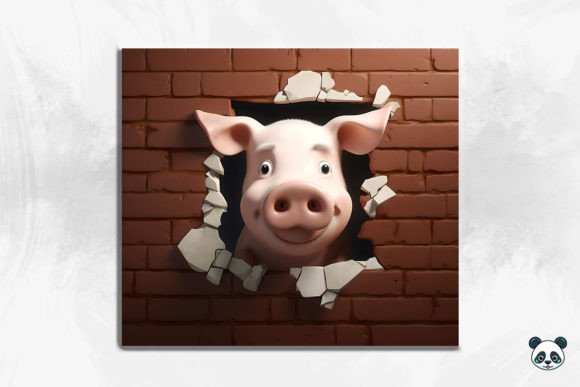
There is a distinct satisfaction in pulling a perfectly printed tumbler from the heat press, where the colors are vibrant, the edges are seamless, and the design looks like it was painted directly onto the metal. However, achieving that professional finish often hinges on the quality of your digital assets and your preparation before you ever turn on the printer. The Donkey 3D Cracked Hole Tumbler Wrap 3 represents a specific style of farm-themed art that combines watercolor textures with a modern 3D cracked-hole effect. While this design offers a unique aesthetic for 20 oz skinny tumblers, many creators rush into the printing process without fully evaluating the file specifications or understanding how to adapt a digital PNG to a physical, curved surface. By taking a moment to review what you are downloading and how you intend to use it, you can save significant time, ink, and blank inventory.
When you purchase an instant digital download like this, you are acquiring a tool, not a finished product. The file typically includes a high-resolution PNG, often sized around 9.3 inches by 8.2 inches at 300 DPI. A common misunderstanding among beginners is assuming that "instant download" means "instant readiness." In reality, the file requires careful handling. One frequent mistake is ignoring the aspect ratio of the wrap relative to your specific tumbler brand. Not all 20 oz skinny tumblers are created equal; some have slightly different circumferences or taper angles. If you apply a wrap designed for one brand onto another without checking the fit, you may end up with unsightly gaps where the background doesn't meet, or worse, the design overlaps awkwardly over the seam. Always measure your blank before committing to a full print run.
Avoiding Resolution and Scaling Pitfalls
The promise of 300 DPI is standard for sublimation, but it can be misleading if the image is scaled incorrectly in your design software. A major error occurs when users stretch the Donkey 3D Cracked Hole Tumbler Wrap 3 to fit a larger area than intended. Because this design features intricate details like the "cracked hole" texture and watercolor farm animal elements, stretching the image dilutes the pixel density. This results in a blurry or pixelated final product, especially noticeable on the smooth, glossy surface of a coated tumbler. To avoid this, never upscale the image beyond its original dimensions provided in the zip file. If your tumbler requires a larger wrap, it is better to find a design specifically sized for that dimension rather than forcing a smaller file to work.
Furthermore, many creators overlook the importance of the background layer in 3D designs. This specific wrap utilizes a seamless pattern concept to create depth. If you attempt to tile this pattern manually without aligning the edges correctly, the "cracked" effect will look broken and disjointed. The file is likely designed to be used as a single continuous wrap for a standard skinny tumbler. Trying to chop it up or repeat it unnecessarily can ruin the illusion of the 3D depth. Trust the composition as provided by the artist, as the placement of the donkey and the surrounding farm elements has likely been balanced to account for the curvature of the cup.
Preparation and Printer Settings Matter
Even with a perfect file, poor printer settings can degrade the quality of farm animal watercolors. These designs often rely on subtle gradients and soft edges to mimic traditional painting. A common oversight is using the wrong color profile or paper type in your printer driver settings. Sublimation ink behaves differently on various transfer papers. If you use a setting meant for plain paper or photo gloss instead of sublimation transfer, the ink saturation may be off. This can cause the rich browns of the donkey or the greens of the background to appear washed out or overly dark. Always perform a test print on regular paper first to check the size and color balance before wasting expensive sublimation paper.
Another practical consideration is the handling of the digital file itself. Since you receive a ZIP file containing the PNG, ensure you extract the file completely before opening it in editing software like Photoshop, Illustrator, or Canva. Working directly from a compressed folder can sometimes lead to temporary file errors or reduced performance. Additionally, verify that your software is set to preserve the transparency if the design includes it, although most full wraps will have a solid background to cover the entire surface. If the design is intended to have a transparent background for layering, printing it over a white base by mistake will alter the intended look significantly.
- Check the Seam Allowance: Ensure your design accounts for the overlap area so the pattern flows naturally without cutting off key elements like the donkey's face.
- Mirror Your Image: It sounds simple, but forgetting to mirror the image before printing is a classic mistake that renders the text and directional elements backward.
- Inspect the Edges: Look closely at the digital file for any stray pixels or white lines on the edges that could result in visible seams after pressing.
- Understand the License: Confirm whether the digital download allows for commercial use if you plan to sell the finished tumblers, as terms vary by creator.
Efficiency in your workflow also comes from organization. When you download multiple designs, such as various farm animal themes or 3D patterns, it is easy to lose track of which file corresponds to which tumbler size. Label your files clearly immediately after extraction. For instance, renaming the file to include "20oz-Skinny-Donkey-3D" helps prevent confusion later. This small step prevents the frustration of printing the wrong design on a costly blank.
Ultimately, the goal is to create a product that feels premium and thoughtful. The Donkey 3D Cracked Hole Tumbler Wrap 3 offers a charming, rustic aesthetic that appeals to many consumers, but its success depends on your attention to detail. By respecting the file limits, understanding your equipment, and verifying your measurements, you transform a simple digital download into a high-quality physical good. Take the time to learn the nuances of your specific blanks and printers. This proactive approach not only reduces waste but also builds your reputation as a creator who delivers consistent, professional results. Whether you are a hobbyist making gifts or an entrepreneur building a brand, these foundational checks are the difference between a mediocre outcome and a masterpiece.